
CodeBranch · Client: Nvidia · Jun 2025 – Apr 2026 (contract)
Redesigning Decision-Making for a Global Supply Chain
Leading the UX transformation of an enterprise supply chain intelligence platform: from a flat interface to a task-oriented SAP Fiori dashboard for global teams moving $2B+ a year.

A flat, unstructured supply-chain platform slowed high-stakes decisions for global teams.
Restructured it into a task-oriented SAP Fiori dashboard with AI recommendation and guardrail patterns, as design lead and Product Owner.
9 of 10 participants in internal usability testing found the new conversational flow easier than the 10-filter query it replaced, on a platform managing $2B+ in annual transactions.
A global supply chain team needed faster, more confident decisions.
I led design and product strategy for Nvidia's supply-chain intelligence platform, an enterprise AI analytics tool managing $2B+ in annual transactions. It served global teams making high-stakes operational decisions on AI-generated insights and real-time data.
The existing interface was flat and unstructured; information was presented without hierarchy, forcing users to mentally organize data before they could act on it. This slowed decision-making and increased error rates, particularly for cross-functional teams who needed different views of the same data.
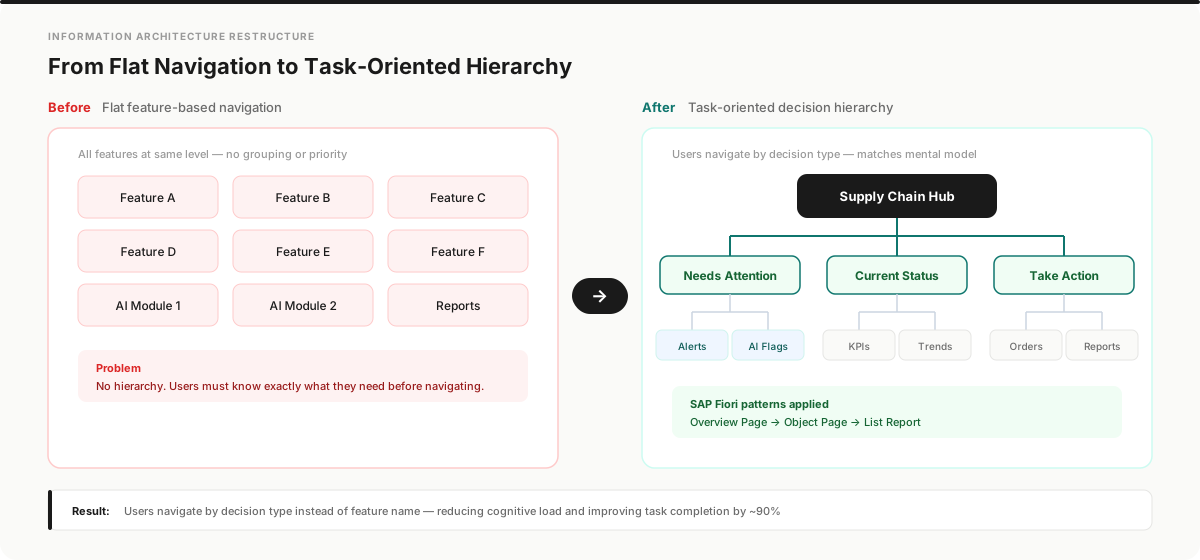
Information architecture: from a flat feature list to a task-oriented decision hierarchy
Enterprise structure meets AI-powered intelligence.
SAP Fiori as the structural foundation. I selected SAP Fiori as the design framework for two reasons: it is the enterprise standard that supply chain teams already understand, and its structured dashboard patterns (Overview Pages, Object Pages, List Reports) map directly to supply chain decision-making workflows.
Information architecture overhaul. I restructured the platform's IA from a flat list of features into a task-oriented hierarchy. Users no longer navigated by feature name; they navigated by decision type: "What needs my attention?", "What is the current status?", "What action should I take?"
AI integration patterns. I designed interaction patterns for AI-generated recommendations that maintained user agency. The AI surfaced insights, but humans made the final decisions, with clear confidence indicators and the ability to drill into the underlying data.
From ten filters to one prompt. Building a query used to mean configuring up to ten filters by hand. I replaced that with a conversational flow: users describe what they need, the AI proposes the query and runs the projection against live platform data. The gain was not speed — it was confidence. Users asked follow-up questions instead of accepting the first answer, tracing a component down to its class and origin without leaving the conversation.
The restructure was validated, not assumed. In internal usability testing with 10 participants — marketing users, not engineers — 9 found the new flow easier and less error-prone than the filter-based query it replaced. The tenth did not: they had built a mechanical habit around the old filters and never realized the same query could now be expressed as a prompt. That was the most useful finding of the round — a discoverability gap in how the interface advertised its own capability, not a failure of the flow itself.

- Fiori Overview Page: the screen answers “what needs my attention?” first
- KPI hierarchy before drill-down. Users navigate by decision, not feature name
- Every AI recommendation ships with a confidence level and the data behind it
- The human decides. The AI surfaces, never auto-executes
Restructured SAP Fiori dashboard with AI recommendation panel (proprietary content redacted under NDA)
Try the Design / Spec toggle
Designing trust into every AI interaction.
- Deep Reasoning UI: the conversational AI end-to-end: onboarding prompts, step-by-step reasoning, structured data tables, and suggested follow-ups, each with transparent reasoning and confidence indicators.
- Guardrails & safety: off-topic and restricted-data queries handled gracefully: the AI explains why and offers in-scope alternatives instead of failing silently.
- Conversation history: context carries forward; retrieved data surfaces as searchable, sortable, exportable tables, and past sessions resume with full context.
The deep-reasoning, guardrails, conversation-history, and data-flywheel screens that bring these patterns to life are withheld under NDA. The interaction design is described above; the full work is available to walk through on request under a mutual NDA.
Beyond design: functional product ownership.
On this project, I operate beyond the traditional designer's scope. Acting as Product Owner on the design side, I write user stories with acceptance criteria so engineering teams understand the intent behind each design decision. I run design QA on the build, facilitate weekly syncs with 5+ engineers including AI/ML specialists, and govern the design system to ensure Atomic Design compliance across the product.
I also mentor 2 junior designers who contribute to the component library and product screens, enabling them to work autonomously within the design system I established.
Leadership & Collaboration
- Cross-functional engineering: I work directly alongside the full-stack engineering team at CodeBranch: translating design decisions into structured acceptance criteria, reviewing PRs for UI fidelity, and pairing on complex interaction implementations.
- Weekly syncs with 5+ engineers: Including AI/ML specialists on the Nvidia side, bridging the gap between design intent and technical feasibility for LLM-powered features like deep reasoning and guardrails.
- Mentoring: Scaled 2 junior designers across the full product suite by establishing a governed Atomic Design system with clear contribution guidelines and component documentation.
- Stakeholder management: Presented design rationale to Nvidia stakeholders through SAP Fiori pattern justifications, choosing Fiori over custom patterns to reduce onboarding friction for supply chain teams already familiar with SAP.